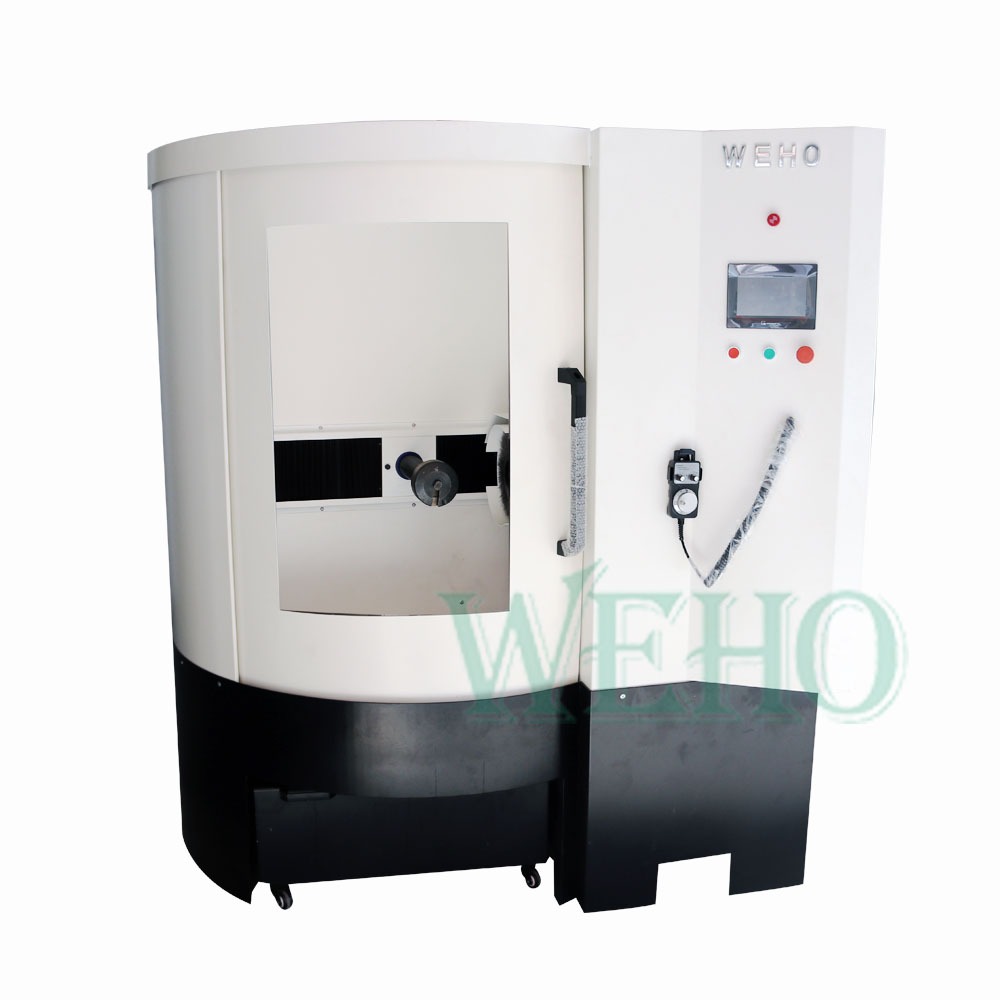
How to Choose a Woodworking Blade Sharpening Machine
Choosing a woodworking blade sharpening machine can be difficult when different blades require different grinding methods. This guide covers the key factors to check, from blade type and size to tooth geometry and production needs, so you can narrow down the right machine for your application.
1. Identify the Blade You Need to Sharpen
Before comparing machines, identify the blade type and material.
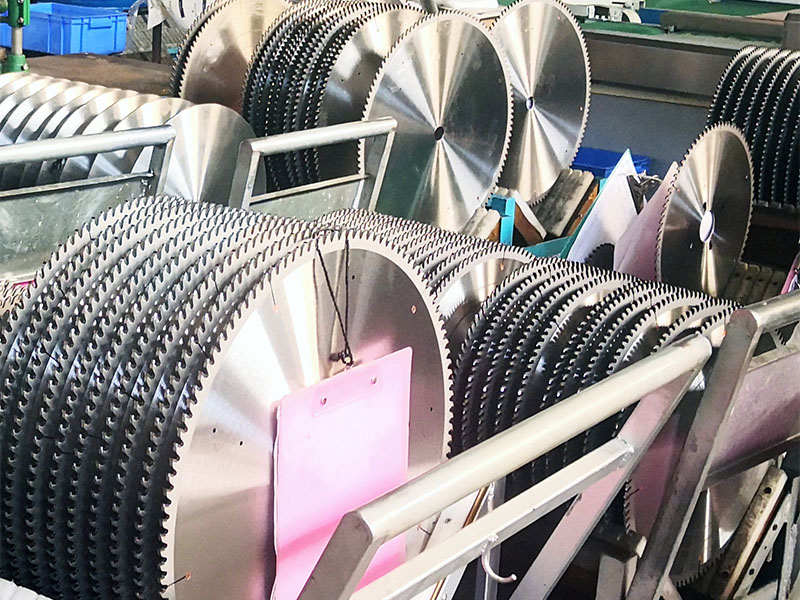
Woodworking operations may use TCT circular saw blades, HSS saw blades, band saw blades, straight knives, and other TCT woodworking tools. These tools have different shapes, materials, and grinding requirements.
WEHO provides different sharpening and grinding machines for these applications. The goal is not to find one machine that handles everything. The goal is to find a machine that matches the blades you actually use.
TCT and HSS Circular Saw Blades
TCT and HSS circular saw blades require different grinding approaches.
TCT circular saw blades use carbide-tipped teeth. WEHO offers several machines for TCT saw blade sharpening, including the CH200, CH800, MF-026B, MF026C, MF668, and MF127.
These machines have different working ranges and configurations. Blade diameter is only one factor. Bore diameter, blade thickness, tooth pitch, tooth geometry, and the required grinding operation should also be checked.
For HSS circular saw blades, the HSS500-3A is specifically designed for HSS saw blade sharpening and grinding. It uses CBN grinding wheels and provides three servo-controlled axes: X, Y, and Z. It supports triangular, arc, high-low, and variable-pitch tooth types.
For a detailed comparison of blade materials and forms, see TCT vs HSS, Circular vs Straight: Which Blade Sharpening Machine Do You Need?.
Band Saw Blades
Band saw blades have a long and flexible structure, so they require a dedicated grinding setup.
WEHO offers the MF-05 and MF600 for different band saw blade applications.
The MF-05 supports blade thicknesses of 0.6–3 mm, blade widths of 27–150 mm, and a maximum grinding length of 5000 mm.
The MF600 supports a maximum sharpening blade width of 125 mm and a maximum grinding length of 8000 mm.
The correct model depends on the dimensions and type of band saw blade you need to process.
For more information, see [How to Choose a Band Saw Blade Grinder].
Straight Knives and TCT Woodworking Tools
Straight knives require a different grinding configuration from toothed saw blades.
WEHO's MF2530AB and MF2530AC provide a maximum grinding length of 3100 mm. The MF2530AC also provides programmable work cycles for roughing, finishing, and spark-out.
For TCT woodworking tools, the MF2720 is designed for grinding different TCT tools, including cutter and planer knife applications.
|
Blade or Tool |
WEHO Machine Examples |
Main Selection Factors |
|
TCT circular saw blade |
CH200, CH800, MF-026B, MF026C, MF668, MF127 |
Diameter, bore, thickness, tooth pitch, grinding method |
|
HSS circular saw blade |
HSS500-3A |
Diameter, bore, teeth, tooth type, grinding angles |
|
Band saw blade |
MF-05, MF600 |
Width, thickness, length, blade type |
|
Straight knife |
MF2530AB, MF2530AC |
Knife length, grinding requirements |
|
TCT woodworking tools |
MF2720 |
Tool type and grinding requirements |
The first rule is simple: identify the blade before selecting the machine.
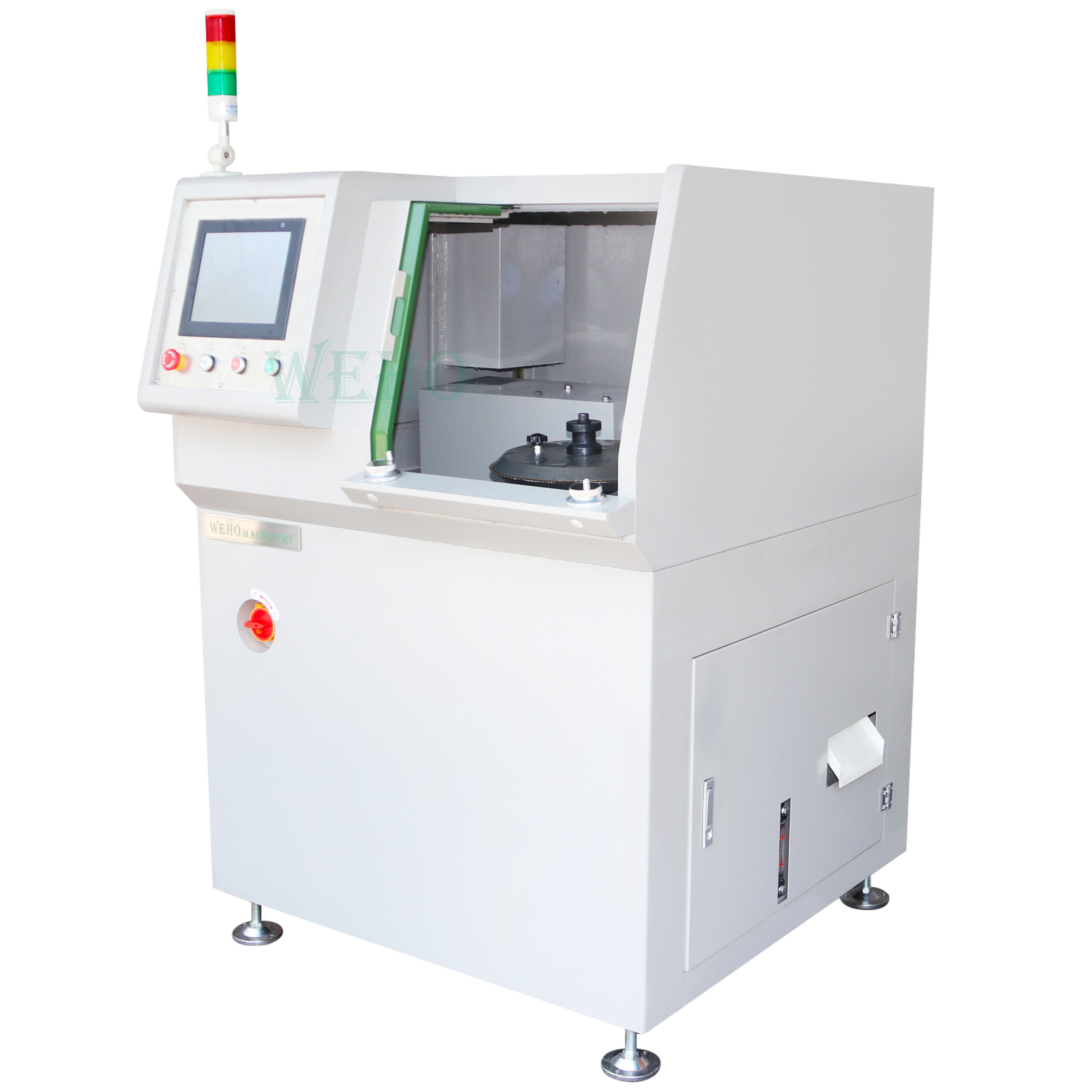
2. Check Blade Size and Working Range
After identifying the blade type, check its actual dimensions.
A machine may be designed for the same general blade category but have a different working range. This is why the machine's specifications should be compared with your actual blade dimensions.
Circular Saw Blade Dimensions
For circular saw blades, check:
- Outside diameter
- Bore diameter
- Blade thickness
- Tooth pitch
- Number of teeth
For example, WEHO's TCT circular saw sharpening machines have different working ranges:
|
Machine |
Saw Diameter |
Bore Diameter |
Max. Blade Thickness |
Tooth Pitch |
|
CH200 |
100–600 mm |
10–105 mm |
8 mm |
8–40 mm |
|
CH800 |
120–810 mm |
10–220 mm |
10 mm |
— |
|
MF-026B |
80–810 mm |
10–220 mm |
10 mm |
7–100 mm |
|
MF026C |
80–810 mm |
10–220 mm |
12 mm |
7–100 mm |
This comparison shows why blade diameter alone should not determine your choice.
Two machines may both support a similar saw diameter while having different bore, thickness, tooth pitch, or grinding capabilities.
HSS, Band Saw, and Straight Knife Dimensions
For HSS circular saw blades, the HSS500-3A supports blade diameters from 120–500 mm, bore diameters from 10–40 mm, and 10–998 teeth. Its listed grinding precision includes face angle ±1.0°, top angle ±1.0°, tooth depth ±0.1 mm, and R ±0.1 mm.
For band saw blades, check blade width, thickness, and grinding length.
The MF-05 supports:
- Blade thickness: 0.6–3 mm
- Blade width: 27–150 mm
- Maximum grinding length: 5000 mm
The MF600 supports a maximum sharpening blade width of 125 mm and maximum grinding length of 8000 mm.
For straight knives, grinding length is a key specification. Both the MF2530AB and MF2530AC provide a maximum grinding length of 3100 mm.
Always compare your complete blade dimensions with the machine's working range before purchasing.
3. Check Tooth Geometry and Grinding Requirements
Blade size tells you whether the blade can physically fit the machine. It does not tell you whether the machine can perform the required grinding operation.
For toothed blades, tooth pitch, tooth configuration, and grinding angles are important.
Tooth Pitch and Tooth Configuration
Tooth pitch varies between different saw blades and applications.
For example:
- CH200: 8–40 mm
- MF-026B: 7–100 mm
- MF026C: 7–100 mm
- MF668: 9–30 mm
The HSS500-3A supports triangular, arc, high-low, and variable-pitch tooth types.
If your blade is within the machine's diameter range but its tooth configuration is outside the supported range, the machine may still not be suitable.
Grinding Angles
Grinding angles should be compared with the actual geometry of the blade.
The MF-026B lists:
- Clearance angle: 6–45°
- Bevel grinding top angle: 0–45°
- Bevel grinding face angle: 3–20°
The MF026C lists:
- Clearance angle: 6–45°
- Bevel grinding top angle: -7–40°
- Bevel grinding face angle: 3–20°
The HSS500-3A lists a cutting angle range of 1–30° and a clearance angle range of 1–30°.
These parameters should be compared with the requirements of your blade rather than selected by machine price alone.
Consider the Required Grinding Operation
You should also identify which part of the blade needs to be ground.
Some TCT circular saw applications require grinding on the top and face of the tooth. Other applications require side grinding.
The MF-D110 is designed for side grinding circular saw blade teeth. Its listed working range includes circular saw outside diameters of 100–900 mm, bore diameters of 12–105 mm, maximum blade thickness of 12 mm, and tooth pitch of 7–70 mm.
This is an important distinction when comparing machines.
A machine with a suitable blade diameter range may still not be suitable if its grinding operation does not match your blade.
4. Consider Grinding Precision, Speed, and Wheel Configuration
Once blade compatibility has been confirmed, consider the grinding performance you need.
For production users, important factors can include grinding precision, working speed, grinding speed, and grinding wheel configuration.
Different machines are designed for different applications, so these specifications should be evaluated in context.
For example, the MF-05 lists a working speed of up to 18 teeth/min and grinding precision of 0.01–0.02 mm.
The MF600 lists a working speed of 18 teeth/min.
The HSS500-3A lists a grinding speed of 1–60 teeth/min.
These figures should not be treated as direct performance rankings because the machines are designed for different blade types and grinding processes.
Grinding Wheel Selection
The grinding wheel is another part of the machine configuration.
WEHO uses different wheel types for different applications.
|
Machine |
Grinding Wheel |
|
HSS500-3A |
CBN grinding wheel |
|
MF2720 |
Diamond wheel |
|
MF-05 |
Ø125 × 32 mm grinding wheel |
The wheel type should be considered together with the blade material and grinding operation.
For example, the HSS500-3A uses a CBN grinding wheel for HSS saw blade grinding, while the MF2720 uses a diamond wheel for TCT woodworking tools.
5. Match the Machine to Your Production Requirements
Blade compatibility comes first. After that, consider how often the machine will be used and how much operator involvement your production requires.
A workshop sharpening a limited number of blades may have different requirements from a production facility processing blades every day.
Manual, Automatic, and CNC Options
WEHO provides different operating configurations.
The MF126 is a manual hand circular saw blade sharpener.
Other WEHO machines provide automatic sharpening functions, including the MF-05, MF600, MF026C, MF668, and MF127.
The HSS500-3A uses three servo-controlled axes for HSS circular saw blade sharpening.
The MF127 provides automatic sharpening procedures after the corresponding blade data is entered.
The correct automation level depends on your actual workload, blade volume, and operator requirements.
You do not necessarily need the most automated machine. First determine which machine can process your blade correctly, then compare the operating method and production capacity.
For a more detailed comparison, see Manual vs Automatic Saw Blade Sharpeners.
6. Match Your Blade With the Right WEHO Machine
After checking blade type, dimensions, tooth geometry, grinding requirements, and production needs, you can narrow down the available machines.
|
Application |
WEHO Machine |
Key Parameters to Check |
|
TCT circular saw blade |
CH200 |
Diameter, bore, thickness, tooth pitch |
|
TCT circular saw blade |
CH800 |
Diameter, bore, thickness |
|
TCT circular saw blade |
MF-026B |
Diameter, bore, thickness, tooth pitch, angles |
|
TCT circular saw blade |
MF026C |
Diameter, bore, thickness, tooth pitch, angles |
|
TCT side grinding |
MF-D110 |
Diameter, bore, thickness, tooth pitch |
|
Automatic TCT saw sharpening |
MF668 |
Diameter, tooth pitch |
|
Automatic TCT saw sharpening |
MF127 |
Diameter, bore, thickness, grinding requirements |
|
HSS circular saw blade |
HSS500-3A |
Diameter, bore, teeth, tooth type, angles |
|
Band saw blade |
MF-05 |
Width, thickness, grinding length |
|
Band saw blade |
MF600 |
Width, blade type, grinding length |
|
Straight knife |
MF2530AB |
Grinding length, knife specifications |
|
Automatic straight knife grinding |
MF2530AC |
Grinding length, grinding requirements |
|
TCT woodworking tools |
MF2720 |
Tool type, grinding requirements |
This table is a starting point, not a final machine recommendation.
The final model should be selected after comparing your actual blade specifications with the machine's working range and grinding configuration.
For the complete product range, visit [WEHO Sharpening & Grinding Machines].
7. Prepare Your Blade Information Before Contacting the Manufacturer
If you are unsure which machine fits your application, prepare your blade information before contacting the manufacturer.
Providing complete information makes it easier to determine machine compatibility.
Blade and Grinding Information
Prepare:
- Blade type
- Blade material
- Blade diameter or length
- Bore diameter
- Blade thickness
- Blade width
- Tooth pitch
- Number of teeth
- Tooth configuration
- Required grinding operation
- Grinding angles
- Required precision
Photos or technical drawings of the blade can also help the manufacturer understand your requirements.
Production Information
You should also provide:
- Sharpening frequency
- Number of blades
- Expected production volume
- Current sharpening method
- Required automation level
This information helps WEHO compare your requirements with the available machine configurations and identify a suitable solution.
WEHO also provides customized saw blade sharpening solutions based on blade type, application, production volume, and workflow requirements.
Conclusion
Choosing a woodworking blade sharpening machine starts with the blade.
Check the blade type, material, dimensions, tooth geometry, grinding operation, and production requirements before comparing machines.
If you already have blade specifications, contact WEHO with the blade details and grinding requirements. WEHO can help match your application with the appropriate sharpening and grinding machine.
FAQs
What should I consider when choosing a woodworking blade sharpening machine?
Start with the blade type and material. Then check the blade dimensions, tooth configuration, grinding operation, required precision, and production requirements.
How do I choose a TCT circular saw blade sharpening machine?
Check the blade diameter, bore diameter, thickness, tooth pitch, tooth configuration, and required grinding operation. Then compare these specifications with the machine's working range.
What machine is suitable for HSS circular saw blades?
The HSS500-3A is designed for HSS circular saw blade sharpening and grinding. It supports HSS saw blade diameters from 120–500 mm and uses CBN grinding wheels.
How do I choose a band saw blade grinder?
Check the blade width, thickness, grinding length, blade type, and sharpening requirements. WEHO offers the MF-05 and MF600 for different band saw blade applications.
What machine should I use for straight knives?
Start with knife length and grinding requirements. The MF2530AB and MF2530AC both provide a maximum grinding length of 3100 mm.
Is a larger sharpening machine always better?
No. The machine should match your actual blade specifications and grinding requirements. A larger working range does not automatically make a machine more suitable.
Do I need a manual, automatic, or CNC sharpening machine?
This depends on your blade volume, production frequency, and operator requirements. First confirm blade compatibility, then select the appropriate operating configuration.