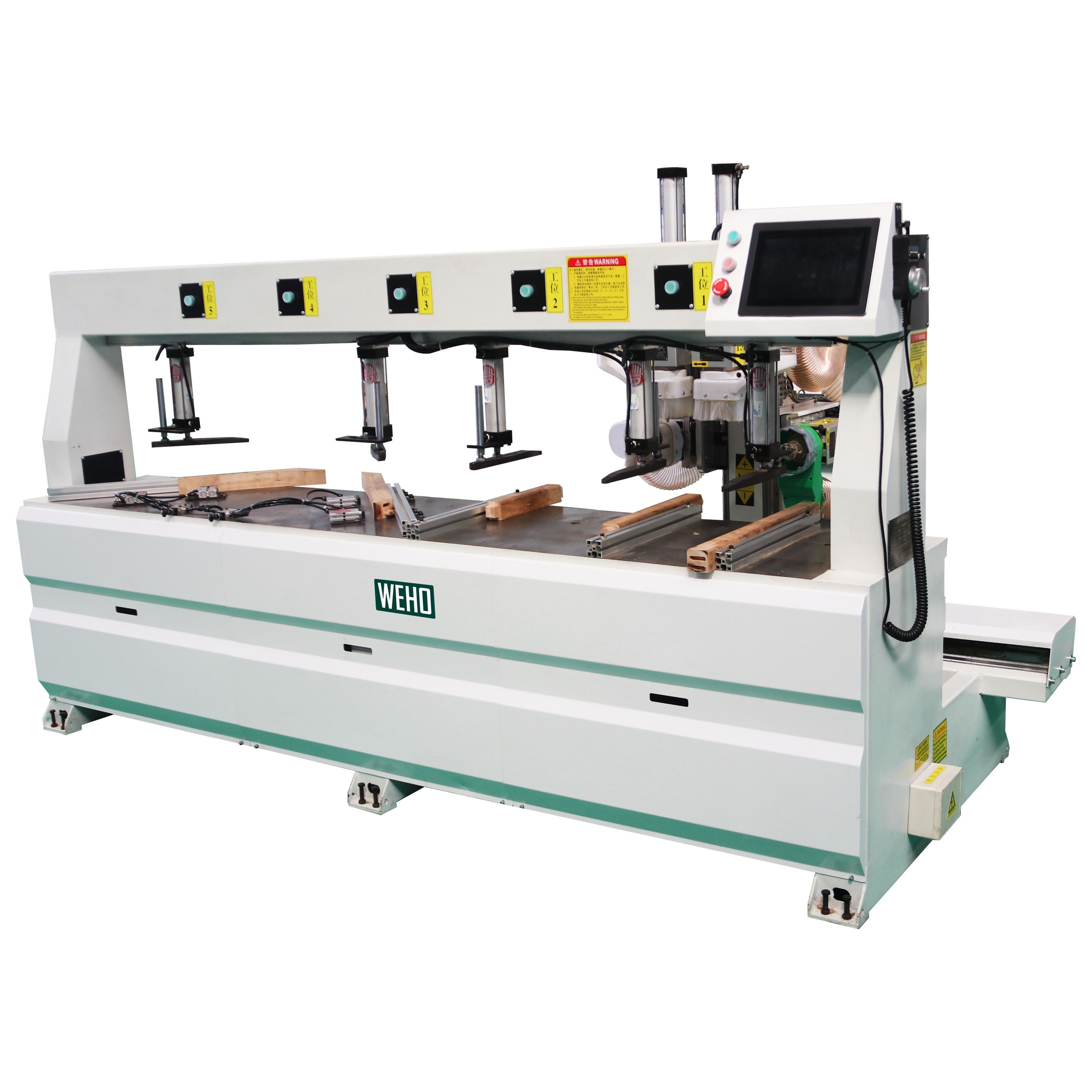
Industrial CNC Tenoner Machines & Systems for Sale
Introduction
Manufacturing workshops in 2026 face unprecedented compounding pressures—rapid inflation of premium timber costs, severe shortages of aging master woodworkers, and strict global workplace safety regulations. Within furniture and cabinetry production, tenoning remains one of the most critical yet challenging joints to execute consistently.
Traditional manual methods create severe bottlenecks, especially in modern high-mix, low-volume environments that demand frequent design changes and precise joints. Upgrading to next-generation CNC tenoner systems solves these issues by delivering micron-level consistency, faster throughput, and a reduced reliance on specialized labor.
Technological Foundations of CNC Tenoner Systems
Multi-Axis Precision and Programmed Trajectories
At the engineering core of modern WEHO CNC Tenon Systems lies an advanced multi-axis servo control infrastructure. Unlike legacy machinery that restricts cutting tools to single, linear movements, modern CNC systems utilize simultaneous multi-axis interpolation to achieve outstanding versatility on the factory floor:
One-Click Structural Profile Adaptation: Operators no longer need to halt production to physically adjust mechanical blades or manual fences. Through an intuitive, graphic-driven Human-Machine Interface (HMI), users can instantly select, load, and execute a diverse array of joint geometries—including standard square tenons, round tenons, oval tenons, complex oblique (mitered) joints, and custom arched or radial tenons—on a single machine platform without a single manual tool change.
Heavy-Duty Structural Rigidity and Machine Bed Engineering: To withstand the massive torsional forces generated during high-speed industrial routing, WEHO CNC tenoners are engineered with premium, stress-relieved, heavy-duty cast-iron or thick-walled welded steel machine bases. This superior structural mass completely dampens harmonic vibrations, ensuring that the tool path remains completely true even during heavy-duty hogging cuts.
High-Frequency Variable Spindle Integration: Our systems feature high-performance, variable-speed, high-frequency internal spindles (typically ranging from 4.0kW to 5.5kW or greater) capable of operating at speeds up to 18,000 to 24,000 RPM. Paired with industrial-grade Polycrystalline Diamond (PCD) or ultra-fine micro-grain Tungsten Carbide cutting tools, these spindles generate glass-smooth surface finishes on tenon shoulders and cheeks, leaving them perfectly prepped for optimal glue adhesion without requiring any post-machining sanding.
Dual-Zone Efficiency Architecture
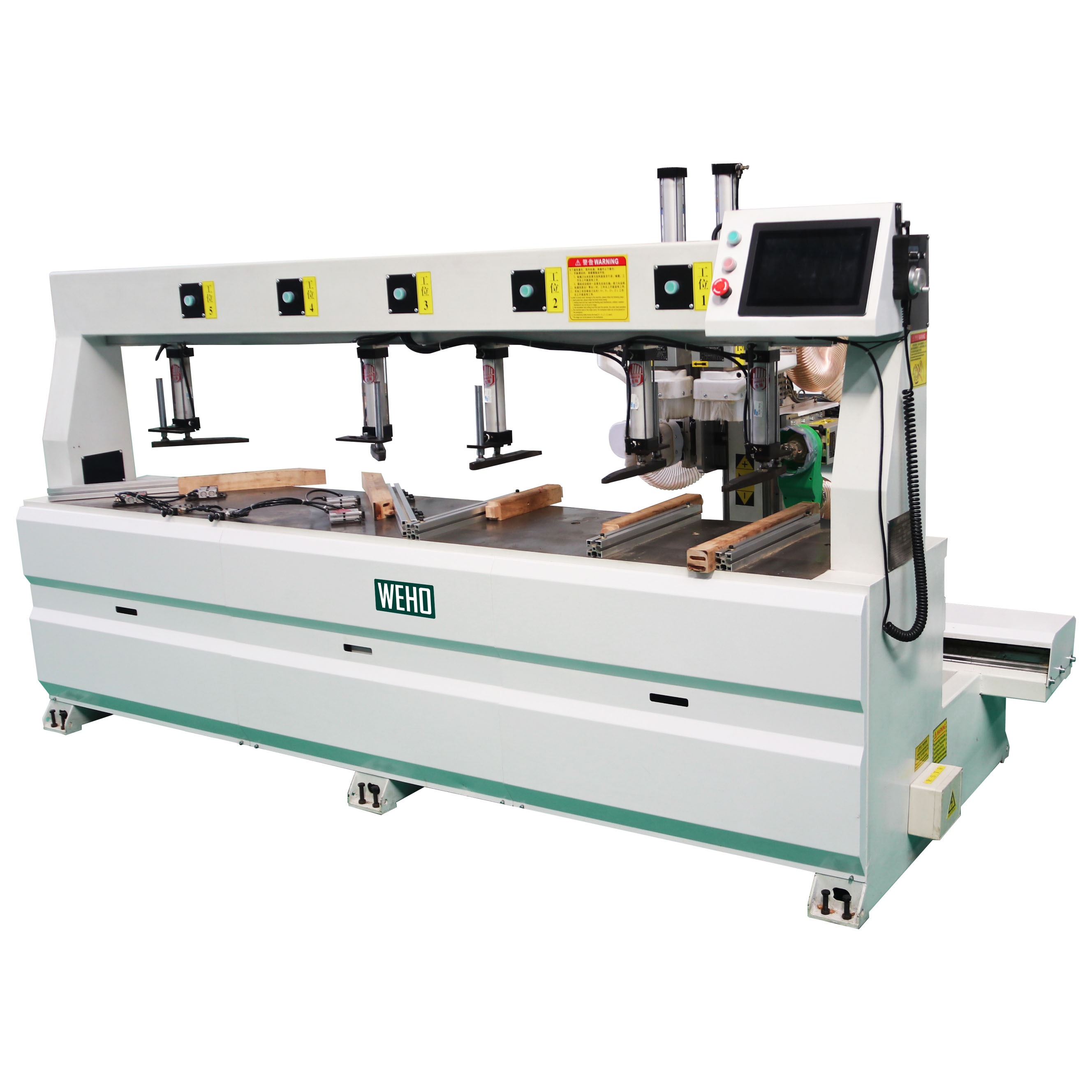
Double-worktable systems enable continuous operation. While the spindle machines parts in one zone, operators safely load and unload workpieces in the other. This setup maximizes spindle runtime and improves overall equipment effectiveness during peak production periods. Pneumatic clamping and fully enclosed zones enhance both productivity and workplace safety.
Predictive Monitoring and Operational Intelligence
Equipped fully for the Industry 4.0 smart factory paradigm, WEHO CNC tenoners feature an integrated network of diagnostic IoT sensors and edge computing capabilities:
Real-Time Spindle Harmonics and Thermal Tracking: Thermal sensors and accelerometers continuously monitor the internal bearing temperature and vibration frequencies of the high-speed spindle. Any anomalous deviation from standard operating thresholds is flagged instantly.
Intelligent Edge Diagnostics: Edge algorithms analyze load currents and vibration data in real time to evaluate cutter sharpness. The system automatically alerts shop floor managers when tool wear reaches critical thresholds, allowing them to schedule tool changes during scheduled breaks rather than experiencing catastrophic tool breakage or part ruining during a live production run.
The Anatomy of Precision Joint Engineering: Engineering Metrics
In high-end architectural joinery, commercial cabinetry, and solid wood furniture assembly, the structural load capacity of a mortise and tenon joint is governed by the glue-line consistency. If a tenon is even 0.5mm too loose, the glue gap becomes too wide, leading to structural failure under cyclic mechanical loads. Conversely, if the tenon is too tight, it will starve the joint of adhesive during assembly or split the grain of the mortise workpiece.
WEHO CNC tenoners hold absolute mechanical tolerances between 180°C structural boundaries to within an incredibly tight range of 0.05mm to 0.1mm. This exceptional dimensional control ensures a perfect "push-fit" every time.
Furthermore, our advanced software-driven tool paths utilize automated scoring cycles. Before the main high-speed router cutter removes bulk material, a specialized pre-scoring utility cuts the outer wood fibers at the shoulder boundary. This sequence completely eliminates grain tear-out and fibers lifting on cross-grain components, guaranteeing sharp, perfectly flush 90-degree shoulders that mate seamlessly against the face of the mortised stile.
Performance Comparison: Traditional vs CNC Tenoner Systems
The following comparative matrix highlights the distinct operational and technological leaps achieved when transitioning from legacy manual or semi-automatic joinery methods to next-generation WEHO CNC Tenon Systems:
|
Operational Metric |
Traditional Manual / Semi-Auto Methods |
WEHO CNC Tenon Systems |
|
Profile Changeover Time |
15 to 30 minutes (Manual adjustment) |
1 to 2 seconds (Digital HMI recall) |
|
Labor Skill Threshold |
Master cabinetmaker required |
Entry-level operator with 2 days training |
|
Machining Accuracy |
Varying tolerances ($\pm0.5\text{mm}$ to $\pm1.0\text{mm}$) |
Strict structural accuracy ($\pm0.05\text{mm}$ to $\pm0.1\text{mm}$) |
|
Processing Yield |
Higher defect rates and material scrap |
Near-zero rework or edge chipping |
|
Operator Safety Level |
Higher risk of contact injury and dust |
Fully enclosed with pneumatic clamping |
|
Daily Output Capacity |
Heavily limited by manual operator fatigue |
Multiplied through continuous cycles |
|
Surface Finish Quality |
Variable depending on manual feed rate |
Consistently smooth, ready for gluing |
Financial Analysis: Calculating ROI and Break-Even
Labor and Throughput Efficiency
CNC tenoners dramatically reduce processing time. A batch of 1,000 standard tenon joints can be completed over 70 percent faster than manual methods. Training new operators now takes only days rather than months, helping workshops overcome labor shortages while sustaining high productivity.
Material Savings and Waste Reduction
Precise programmed paths minimize edge chipping, splitting, and misalignment on premium materials. Improved material utilization strengthens profit margins and reduces scrap, particularly on costly solid hardwoods and laminates. Most installations achieve full payback within 4 to 8 months through combined labor savings, reduced waste, and higher output.
Additional Operational Advantages
- Accessible CAD/CAM Integration: The user-friendly HMI system supports direct macro-programming, allowing operators to adjust joint dimensions graphically without needing to write complex G-code.
- Scalable Footprint: Workshops can double or triple their weekly joint output without increasing their physical floor space or expanding assembly headcount.
- Cellular Manufacturing Ready: WEHO CNC tenoners are engineered to integrate seamlessly with digital upcut saws, edgebanders, and CNC mortisers to build highly automated, connected production cells.
Conclusion
CNC tenoner technology has become an essential asset for workshops seeking long-term competitiveness and operational resilience. As a leading provider of rugged, high-performance CNC woodworking machinery, WEHO combines heavy-duty mechanical construction with intelligent automation and user-focused design to deliver exceptional joinery solutions. Workshops ready to elevate their production capabilities are encouraged to explore WEHO CNC Tenoner systems by sending typical part drawings and production requirements to receive a complimentary ROI analysis and a tailored machine configuration recommendation designed specifically for their needs.
FAQs
Q1: How long does it take for new operators to become proficient?
Most operators reach full productivity within 2 to 3 days using the intuitive HMI and preset profiles.
Q2: What materials can the machine process?
The system works effectively with solid hardwoods, MDF, plywood, laminated boards, and engineered wood.
Q3: How quickly is the investment recovered?
Typical payback periods range from 4 to 8 months in active production settings.
Q4: What maintenance is required?
Predictive sensors enable condition-based maintenance, greatly reducing unplanned downtime.
Q5: Is it suitable for smaller workshops?
Yes. The compact dual-zone design and user-friendly software make it practical for various workshop scales.