
TCT vs HSS, Circular vs Straight: Which Blade Sharpening Machine Do You Need?
Not every woodworking blade needs the same sharpening machine. TCT and HSS blades require different grinding approaches, while circular saws and straight knives use different machine configurations.
This guide compares these blade types and explains how they relate to WEHO sharpening and grinding machines.
TCT and HSS: Different Materials, Different Grinding Needs
TCT and HSS are both used for cutting tools, but they have different material properties and tooth structures. These differences affect the grinding process, grinding wheel, and machine configuration.
For woodworking applications, blade material is only one part of the selection process. The blade form, tooth geometry, dimensions, and required grinding operation also need to be considered.
TCT Saw Blades
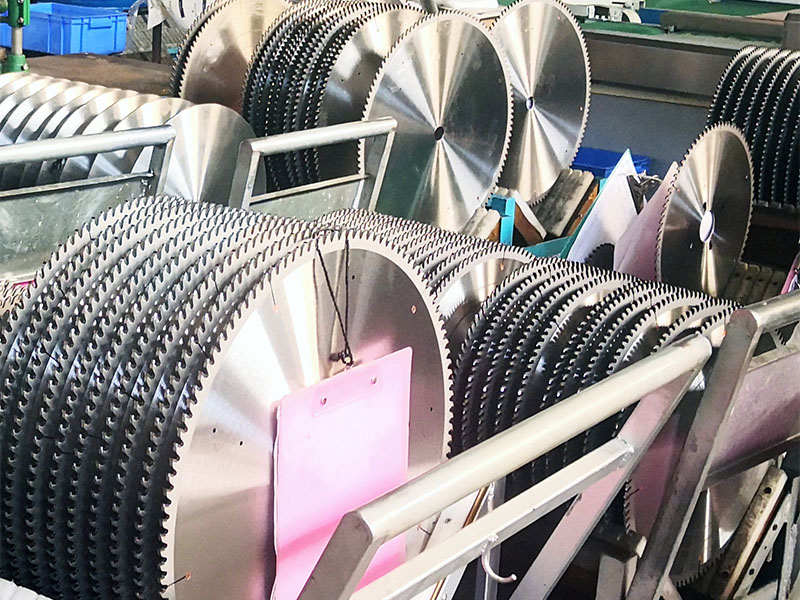
TCT stands for tungsten carbide tipped. In a TCT circular saw blade, carbide tips form the cutting edges of the individual teeth.
The tooth geometry can vary according to the cutting application. Depending on the blade design, sharpening may involve the top, face, or side of the tooth.
This is why TCT circular saw sharpening machines need suitable grinding positions and angle adjustments.
WEHO offers several machines for TCT and carbide circular saw blade applications.
The CH800 is designed for TCT circular saw blades. It supports saw outside diameters from 120 to 810 mm, bore diameters from 10 to 220 mm, and maximum blade thicknesses of 10 mm. Its listed tooth pitch range is 25–100 mm.
For applications that specifically require side grinding, the MF-D110 is designed for the side grinding of circular saw blade teeth. It supports saw outside diameters from 100 to 900 mm, bore diameters from 12 to 105 mm, maximum blade thickness of 12 mm, and tooth pitch from 7 to 70 mm.
The important point is that a machine for general TCT saw sharpening is not necessarily suitable for every grinding operation. The actual tooth geometry and grinding method need to be checked first.
HSS Saw Blades
HSS stands for high-speed steel.
HSS circular saw blades have a different material structure from TCT blades. Their grinding process must therefore match the HSS blade material, tooth geometry, and required grinding precision.
The HSS500-3A is designed specifically for HSS circular saw blade sharpening and grinding.
It uses a CBN grinding wheel and three servo-controlled axes: X, Y, and Z. The machine supports triangular, arc, high-low, and variable-pitch tooth types.
Its listed grinding precision includes:
|
Parameter |
Precision |
|
Face angle |
±1.0° |
|
Top angle |
±1.0° |
|
Tooth depth |
±0.1 mm |
|
R |
±0.1 mm |
The HSS500-3A supports blade diameters from 120 to 500 mm and bore diameters from 10 to 40 mm.
For applications requiring automatic chamfering, WEHO also offers the HSS500-4A, which uses four servo-controlled axes and provides automatic chamfering within its specified working range.
TCT vs HSS
|
Feature |
TCT Saw Blade |
HSS Saw Blade |
|
Cutting material |
Tungsten carbide tipped teeth |
High-speed steel |
|
Common form |
Circular saw blade |
Circular saw blade |
|
Main grinding focus |
Carbide tooth geometry |
HSS tooth geometry |
|
Grinding wheel example |
Diamond, depending on application |
CBN |
|
Tooth configuration |
Depends on blade design |
Triangular, arc, high-low, variable pitch |
|
WEHO examples |
CH800, MF-D110 |
HSS500-3A, HSS500-4A |
The key difference is the relationship between blade material, tooth geometry, and grinding configuration.
If you are comparing different machine specifications, see our How to Choose a Woodworking Blade Sharpening Machine for the broader selection process.
Circular Saw Blades vs Straight Knives
TCT and HSS describe blade materials. Circular and straight describe blade forms.
This distinction is equally important because the grinding movement changes with the blade structure.
A circular saw blade has multiple teeth arranged around a disc. A straight knife has one continuous cutting edge. The machines used for sharpening them are therefore built around different grinding processes.
Circular Saw Blade Grinding
Circular saw sharpening is normally performed tooth by tooth.
The machine must position the blade and grinding wheel accurately for each tooth. Depending on the blade design, the grinding process may involve top grinding, face grinding, side grinding, or a combination of operations.
Important blade specifications include:
- Outside diameter
- Bore diameter
- Blade thickness
- Tooth pitch
- Number of teeth
- Tooth geometry
- Grinding angles
The CH800 is designed for TCT circular saw blade applications and supports saw diameters from 120 to 810 mm.
When side grinding is required, the MF-D110 provides a dedicated solution. Its two grinding heads are designed for the side grinding of circular saw blade teeth.
This means the machine should be selected according to the actual grinding operation, rather than the saw diameter alone.
Straight Knife Grinding
Straight knives have no individual saw teeth. Their cutting edge runs continuously along the length of the blade.
This changes the grinding process.
Straight knife grinding focuses more on the knife dimensions, grinding length, edge geometry, and required precision.
WEHO's MF2530AB is a straight knife grinding machine with a maximum grinding length of 3100 mm. Its listed grinding precision is 0.01–0.02 mm, and the cutter rest adjustable angle is 0–90°.
The MF2530AC also provides a maximum grinding length of 3100 mm. It adds programmable work cycles for roughing, finishing, and spark-out. The machine is designed for industrial straight knives and uses PLC control for carriage movement.
Typical applications include:
- Chipper knives
- Crusher knives
- Granulator blades
- Veneer knives
- Guillotine blades
- Paper knives
Circular Saw vs Straight Knife
|
Factor |
Circular Saw Blade |
Straight Knife |
|
Shape |
Circular |
Straight |
|
Cutting edge |
Multiple teeth |
Continuous edge |
|
Main dimensions |
Diameter, bore, thickness |
Length, width, thickness |
|
Grinding movement |
Tooth-by-tooth |
Along the blade length |
|
Main grinding factors |
Tooth geometry and angles |
Edge geometry and grinding length |
|
WEHO examples |
CH800, MF-D110 |
MF2530AB, MF2530AC |
A circular saw sharpener and a straight knife grinder are designed around different mechanical movements. They should not be treated as interchangeable machines.
Band Saw Blades: A Different Grinding Application
Band saw blades form a continuous strip, so their grinding requirements differ from both circular saw blades and straight knives.
The machine needs to accommodate the blade width, thickness, grinding length, and tooth configuration.
What Matters When Grinding Band Saw Blades?
The main factors include:
- Blade width
- Blade thickness
- Grinding length
- Tooth configuration
- Blade material
- Sharpening speed
WEHO's MF-05 is designed for automatic band saw blade grinding. It supports blade thicknesses from 0.6 to 3 mm and blade widths from 27 to 150 mm.
Its maximum grinding length is 5000 mm, with a working speed of up to 18 teeth/min.
For larger sawmill applications, the MF600 supports band saw blades up to 125 mm wide and a maximum grinding length of 8000 mm. Its listed working speed is 18 teeth/min. The machine can be used for carbide-tipped, HSS, BI dual band saw, and frame saw blades.
|
Blade Type |
Main Parameters |
WEHO Examples |
|
TCT circular saw |
Diameter, bore, thickness, tooth pitch |
CH800 |
|
HSS circular saw |
Diameter, tooth type, grinding requirements |
HSS500-3A |
|
Straight knife |
Length, width, grinding length |
MF2530AB, MF2530AC |
|
Band saw |
Width, thickness, grinding length |
MF-05, MF600 |
For a more detailed look at this application, see our Band Saw Blade Grinding Machines.
The Grinding Wheel Matters Too
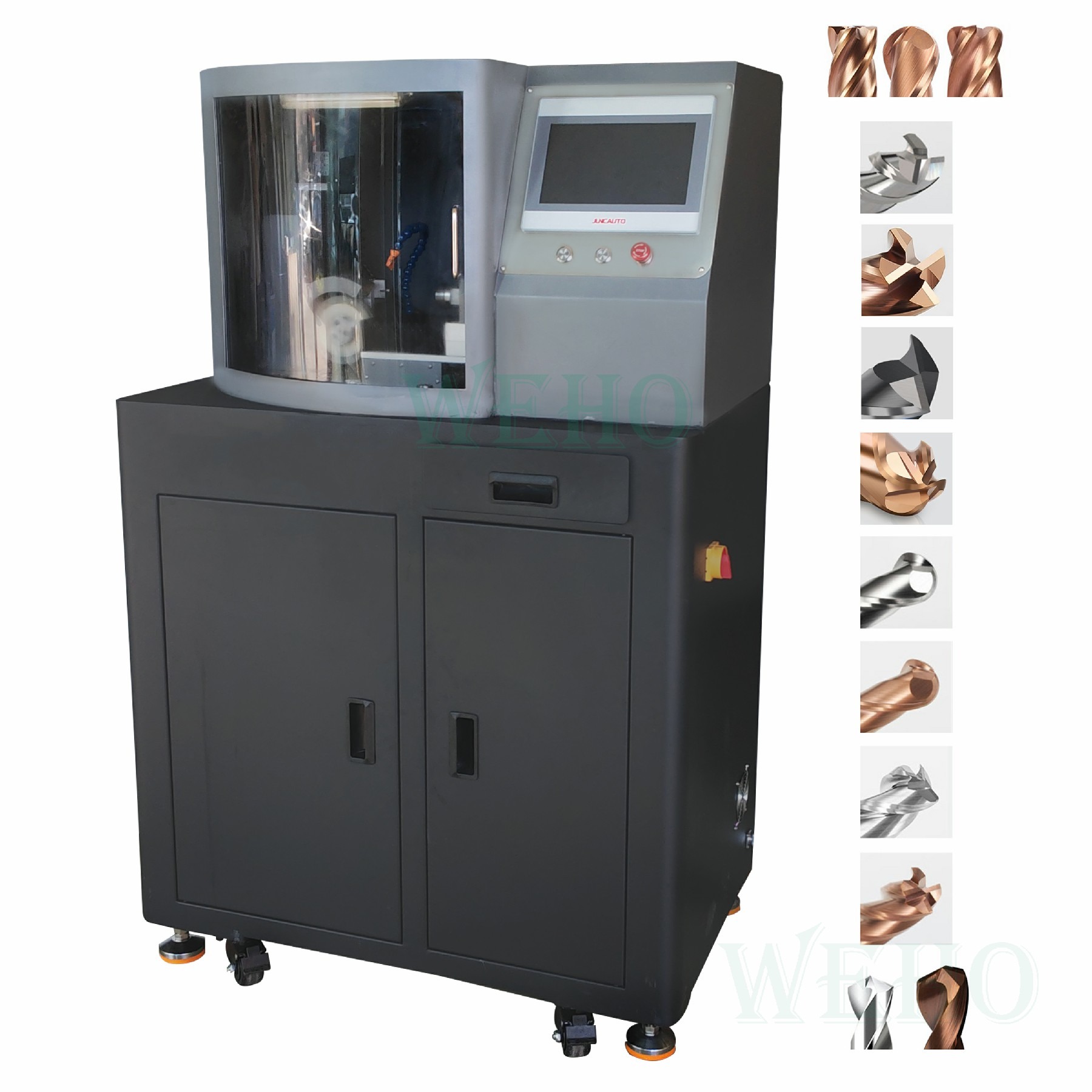
Blade material and grinding operation also affect the grinding wheel.
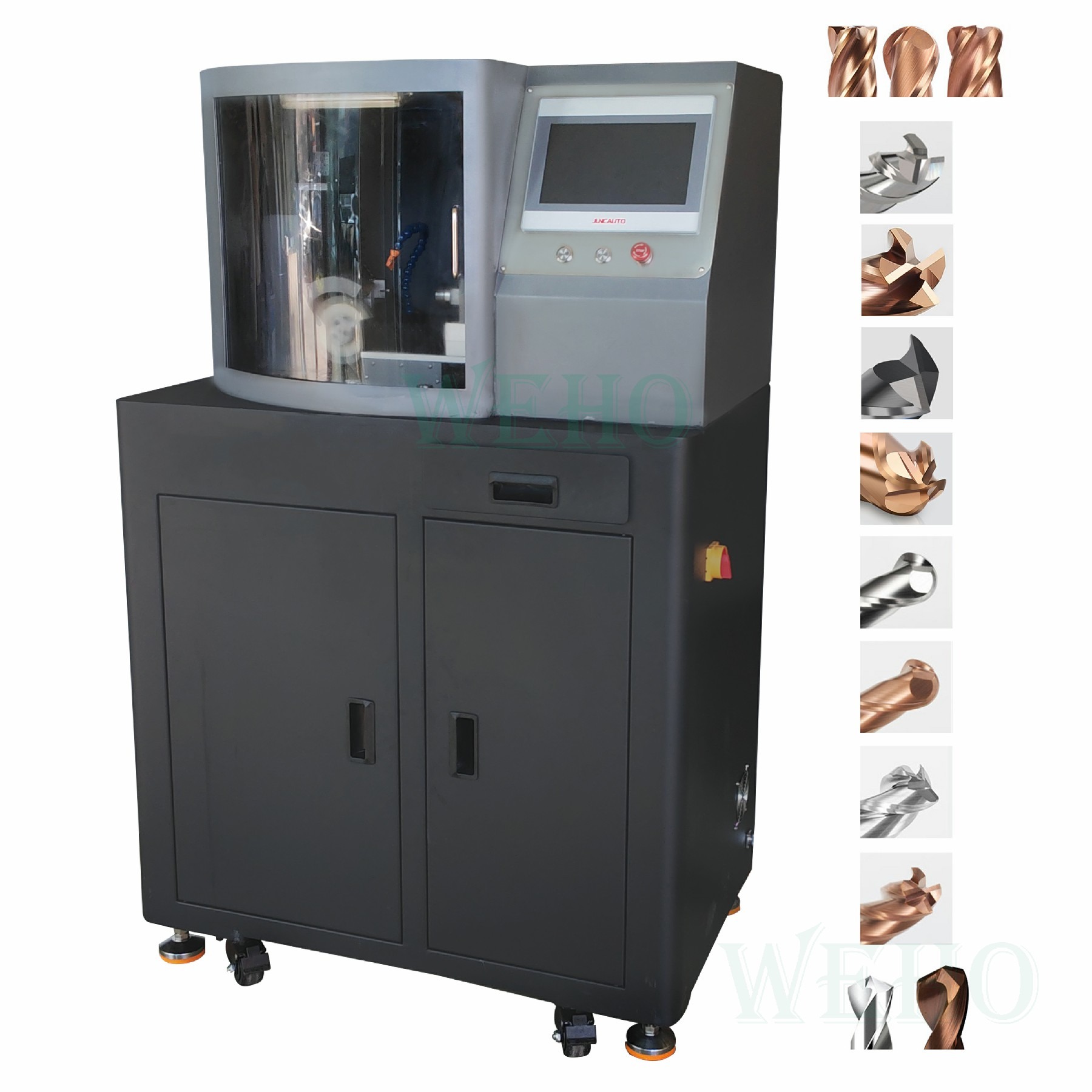
The wheel should not be considered separately from the machine. It needs to match the blade material, grinding process, and machine configuration.
TCT and Diamond Grinding
TCT and carbide tools are commonly associated with diamond grinding applications.
WEHO's MF2720 Universal Tool Grinding Machine uses a diamond grinding wheel for TCT woodworking tools.
The MF2720 is designed for tools such as:
- Grooving cutters
- Moulding cutters
- Router bits
- Carbide saws
- Planer knives
Its listed grinding capacity includes a cutter rotary diameter of up to 300 mm, grinding saw diameter from 105 to 500 mm, and planer knife length up to 350 mm.
The MF2720 is different from a dedicated circular saw blade sharpener because it is designed for a broader range of TCT woodworking tools.
HSS and CBN Grinding
For HSS circular saw blades, the HSS500-3A uses a CBN grinding wheel.
The machine combines the CBN grinding wheel with servo-controlled axes to control the required grinding movements.
This is one reason blade material needs to be identified before selecting a sharpening machine.
The grinding wheel is part of the complete grinding system. It should match the blade material and the required grinding operation.
Which WEHO Sharpening Machine Matches Your Blade?
Once the blade form, material, and grinding process are clear, the appropriate machine category becomes easier to identify.
|
Your Blade or Tool |
Grinding Application |
WEHO Machine Example |
|
TCT circular saw blade |
Carbide tooth grinding |
CH800 |
|
TCT circular saw blade |
Side grinding |
MF-D110 |
|
HSS circular saw blade |
HSS tooth sharpening |
HSS500-3A |
|
HSS circular saw blade |
Tooth grinding with chamfering |
HSS500-4A |
|
Band saw blade |
Automatic tooth grinding |
MF-05 |
|
Larger band saw blade |
Sawmill blade grinding |
MF600 |
|
Straight knife |
Straight-edge grinding |
MF2530AB |
|
Industrial straight knife |
Programmable grinding |
MF2530AC |
|
TCT woodworking tools |
Tool grinding |
MF2720 |
This table provides a starting point for identifying the machine category.
The final selection should still be checked against the actual blade dimensions and grinding requirements.
TCT Woodworking Tools Are Not Limited to Circular Saws
TCT woodworking tools include more than circular saw blades.
Depending on the application, workshops may also use grooving cutters, moulding cutters, router bits, carbide saws, and planer knives.
The MF2720 is designed for these broader TCT woodworking tool applications. It combines different cutter-head configurations with a diamond grinding wheel and supports several types of TCT tools.
This makes it important to distinguish between a dedicated saw blade sharpener and a universal woodworking tool grinding machine.
For the complete product range, see our Sharpening & Grinding Machines.
Before Choosing a Machine
The machine selection process does not need to start with a long list of technical specifications.
A few basic details can usually define the right machine category:
|
Information |
Examples |
|
Blade material |
TCT, HSS |
|
Blade form |
Circular, straight, band saw |
|
Blade size |
Diameter, length, width |
|
Blade thickness |
Actual blade thickness |
|
Tooth information |
Tooth pitch, number of teeth, tooth type |
|
Grinding operation |
Top, face, side, straight-edge |
|
Production requirement |
Manual, automatic, production volume |
Photos or drawings of the blade can also help clarify the actual grinding requirements.
If you need a broader guide to the selection process, see How to Choose a Woodworking Blade Sharpening Machine.
Conclusion
The machine should follow the blade, not the other way around.
TCT, HSS, circular, straight, and band saw blades each have different grinding requirements. Match the blade form, material, and grinding operation with a WEHO machine designed for that application.
FAQs
Is TCT or HSS better for woodworking saw blades?
TCT and HSS are different cutting materials. The suitable choice depends on the blade design, cutting application, and required performance.
The sharpening machine should then be selected according to the actual blade material and grinding requirements.
Can one machine sharpen both TCT and HSS blades?
It depends on the machine configuration and supported blade specifications.
TCT and HSS can require different grinding wheels and grinding processes. The manufacturer's specified application range should always be checked before selecting a machine.
What machine is used for TCT circular saw blades?
WEHO offers several machines for TCT circular saw applications.
The CH800 is one example. It supports TCT circular saw blades with outside diameters from 120 to 810 mm.
What machine is used for HSS circular saw blades?
The HSS500-3A is designed for HSS circular saw blade sharpening and grinding.
It uses a CBN grinding wheel and supports several tooth configurations.
What is the difference between circular saw and straight knife grinding?
Circular saw blades have individual teeth that are sharpened according to their tooth geometry.
Straight knives have a continuous cutting edge and require grinding along the blade length.
Which WEHO machine is suitable for TCT woodworking tools?
The MF2720 is designed for a range of TCT woodworking tools, including grooving cutters, moulding cutters, router bits, carbide saws, and planer knives.